What Makes Wholesale Fruit Tree Organic Fertilizer Eco-Friendly?
Understanding What Makes Organic Fertilizer Eco-Friendly
- Understanding What Makes Organic Fertilizer Eco-Friendly
- Key Components and Types of Wholesale Fruit Tree Organic Fertilizers
- Comparing Organic vs. Chemical Fertilizers for Fruit Trees: Eco and Procurement Perspectives
- Best Practices for Using Wholesale Organic Fertilizer on Fruit Trees
- Choosing Trusted Wholesale Suppliers of Eco-Friendly Organic Fertilizer for Fruit Trees
- Conclusion
- FAQ
- Partner with Sciground for Reliable Wholesale Fruit Tree Organic Fertilizer Supply
- References
You can tell that Wholesale Fruit Tree Organic Fertilizer is eco-friendly because it comes from natural, reusable sources like manure that has not been burned, plant waste, and microbial waste. Unlike synthetic options, these fertilizers break down fully in the environment, release nutrients slowly through microbial activity, and don't let dangerous chemicals run off into waterways and pollute them. Their production leaves a much smaller carbon footprint, and using them rebuilds soil structure, increases wildlife, and helps orchard environments stay healthy. Because of this, they are the best choice for farmers who care about the environment and buying managers who want to make sure the land stays healthy over time while also following the rules.
Understanding What Makes Organic Fertilizer Eco-Friendly
Organic fertilizers are good for the environment because of how they are made and how long they last. These products come from carbon-based materials like animal manure, food waste, peat moss, and microbial communities. Because they are biodegradable, they break down naturally and don't leave behind chemicals that stay in the earth or waterways. Renewable raw materials mean that production doesn't use up limited resources. This is very different from making synthetic nitrogen, which uses a lot of energy and fossil fuels.
The environmental benefits of business-to-business purchases in agriculture go beyond simple claims of sustainability. The main benefit is better soil health, because organic matter increases porosity and ventilation, undoing the damage done by heavy machinery and too much manufactured use. The water quality gets a lot better because slow-release devices stop nutrients from leaking. Soluble nitrates from chemical fertilizers quickly dissolve in water, where they cause eutrophication and dead zones. Organic substitutes only release nutrients when microorganisms in the soil break them down into minerals. This matches the rate at which plants take them up and reduces waste.
For large-scale activities, global approvals back up eco-claims. Products must meet strict environmental standards in order to be listed by the OMRI, be organic in the EU, or be in line with USDA National Organic Program requirements. These certificates make sure that there are no banned synthetic additives, that the materials were sourced in a safe way, and that there is openness throughout the supply lines. These third-party validations help wholesale buyers show that they are following the rules to customers or meet the export standards for organic product markets.
For industrial trees, the ability to grow without hurting the environment is still very important. Modern methods for making organic fertilizer use fermentation systems that use less energy and high-temperature cleaning that kills germs while leaving good bacteria alone. This large-scale processing keeps things the same across big sales, which solves a common problem buyers have with organic products being different.
Key Components and Types of Wholesale Fruit Tree Organic Fertilizers
Knowing what's in Wholesale Fruit Tree Organic Fertilizers helps people who buy things match goods to the needs of each crop. The trade market is mostly made up of three main types, and each one has its own environmental and farming benefits.
Compost-Based Formulations
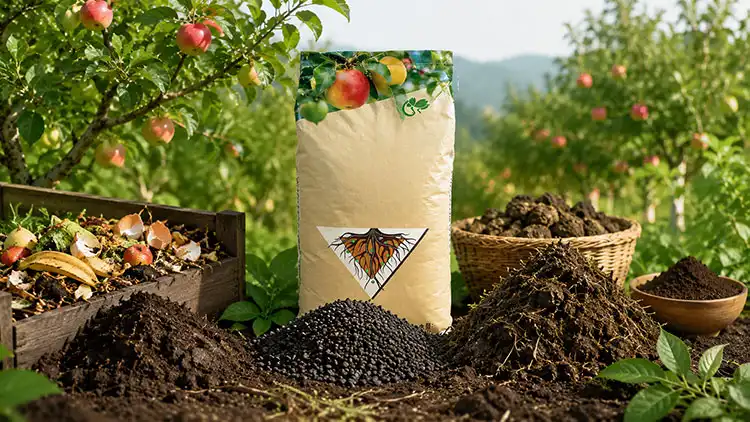
Compost-based nutrients use materials like food waste, broken-down plants, and leftovers from farming. Composting keeps organic matter stable, concentrates nutrients, and grows a wide range of microorganisms. These items are great at making the soil stronger and keeping water in it. Their normal NPK ratios are between 1-1-1 and 3-3-3, which gives them balanced nutrients. The high amount of organic matter—often more than 45%—directly helps to store carbon in crop grounds, which helps with climate change goals and feeds trees at the same time.
Manure-Derived Products
A lot of bulk fruit tree fertilizers are made from livestock dung from cows, chickens, or sheep. When aged and fermented properly, these materials provide rich nutrition profiles with more nitrogen than waste alone. High-quality goods keep their wetness levels below 20% to stop the growth of pathogens and keep them stable during storage. Our team at Sciground uses a fermentation process with high-temperature stages that get rid of weed seeds and bad bacteria while keeping good organisms like Bacillus subtilis that stop soil-borne diseases that hurt fruit trees.
Bio-Organic and Microbial Varieties
Bio-organic nutrients that are more advanced mix natural organic matter with bacteria strains that have been specially grown. Root rot pathogens are fought off by Trichoderma species, and nitrogen-fixing bacteria make nutrients more available. "Soil Exhaustion Syndrome" is common in intensive orcharding, where constant output uses up trace elements like iron, zinc, and boron. These special formulations help fix the problem. Our study with experts from the Northwest Academy of Agricultural Sciences has been mainly about improving microbial consortia for use on fruit trees. We want to make sure that these live components stay viable during storage and start working right away when they are applied.
Because these vegetable parts help with the nutrient cycle, they are truly eco-friendly. Soluble chemical fertilizers give quick but short-lived spikes in nutrients. Organic materials, on the other hand, release nutrients slowly as microbes break down complex molecules. The slow-release mechanism works with the different stages of a fruit tree's life, from the spring buds breaking through to fruit growth and healing after harvest. This makes good use of nutrients with little waste, lower application rates, and safety for areas nearby from runoff from farming.
Comparing Organic vs. Chemical Fertilizers for Fruit Trees: Eco and Procurement Perspectives
When wholesale buyers are looking at fertilizer choices, they need to be able to easily compare them based on how they affect the environment and how well they do financially. When looking at results over full production cycles instead of just one season, organic fertilizers show similar or better results across a number of important measures.
Growth Performance and Fruit Quality
After a transition phase, field tests in industrial apple, citrus, and stone fruit farms show that organic programs produce returns that are similar to those of conventional systems. Even better, measurements of fruit quality often get better. Brix values, which measure sugar content, usually rise by one to two points when organic nutrition is added. This means that the food tastes better and has more market value. Balanced nutrition that doesn't force too much plant growth at the cost of fruit development makes the food more stable over time. These quality benefits are important for bulk businesses that want to sell to high-end customers, since organic approval comes with higher prices.
Environmental and Health Risk Reduction
Many choices about what to buy are based on worries about chemical residues, especially for businesses that export to markets with strict maximum residue limits. With organic nutrients, this risk is completely gone. The safety of the workers goes up a lot because they aren't exposed to synthetic poisons that need protection gear or breaks between entries. Chemical spills, storage dangers, and application drift onto nearby properties or waterways are no longer a threat to the environment.
The use of artificial fertilizers has a secret cost: the soil is getting worse. A lot of synthetic formulas have high salt levels that hurt the structure of the soil and hurt good creatures. Over time, soils that are compacted and naturally drained need more inputs to keep returns the same. This trend is slowed down by Wholesale Fruit Tree Organic Fertilizer programs, which improve the soil's health and lower its long-term input needs. Agricultural schools' research shows that adding just 1% more organic matter can increase the soil's ability to hold water, which can add an extra week of drought resistance. This is a good way to protect yourself against changes in the weather.
Total Cost Analysis
Chemical nutrients tend to be more expensive at first, but when you look at the total cost of ownership, you see a different picture. The economic situation changes when you take into account maintaining healthy soil, lowering the risk of disease, less work needed to apply fertilizer because it is fed less often, and higher prices for organically approved fruit. Studies that look at transition orchards over more than one year show that break-even points usually happen in years two and three, and after that, the orchards make more money.
Reliability of the supplier and trustworthiness of the certification become very important in this study. Reputable companies like Sciground keep the quality high by checking everything thoroughly and being open about their supply lines. Our goods meet national standards because they have a limited amount of moisture, a confirmed amount of organic matter, and proof that they don't contain any banned chemicals. This stability gets rid of the variation that can happen with organic programs, so buying managers can be sure that large-scale operations will run as planned.
Best Practices for Using Wholesale Organic Fertilizer on Fruit Trees
To get the most out of both environmental benefits and efficiency, you need to use your tools in a way that is in line with how trees work and the conditions in your field. When organic fertilizer projects are well-planned, they get better results while having less of an effect on the environment.
Application Timing and Methods
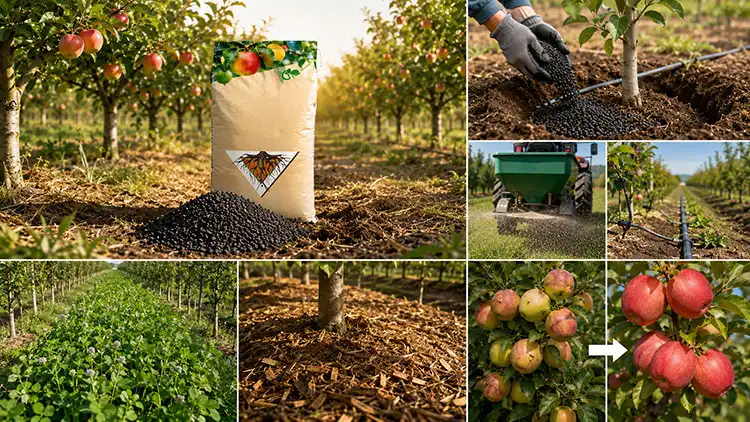
Nutrition programs run all year long are based on post-harvest applications in the fall. This "confinement fertilizer" method fills up trees' energy stores that were used up by making fruit. It does this by building up carbohydrate stores that are important for winter toughness and blooming in the spring. When you use organic fertilizers at this time, the warm and wet fall soil starts to break down the fertilizer, making nutrients available for the important root flush that happens before the leaves come out. Putting a radial ditch or a circle furrow at the tree's dripline makes sure that nutrients get to the active feeder roots while keeping the stem from touching the roots, which could spread disease.
Granular formulas work well for spread or banded applications, especially during the setup and maintenance steps. With mechanical tools, these 2–4 mm particles are spread out evenly, covering big fields in the same way. During important growth times, liquid concentrates can help. For example, fertigation delivers amino acids and potassium through drip systems, which helps the fruit expand. This precise feeding keeps trees from getting stressed from salt while giving them nutrients right when they need them.
Integration with Sustainable Practices
When organic fertilizer is used as part of a full crop management system, it has the biggest positive effect on the environment. Cover crops planted between tree rows fix nitrogen in the air, keep weeds down, and add organic matter to the soil when they are mowed and mixed in. Cover crops with legumes, like vetch or clover, add organic nitrogen to the soil, which cuts the need for bought fertilizer by 20 to 40 percent. Cover crops that aren't legumes, like grasses, make the soil more stable and stop it from washing away when it rains in the winter.
Putting mulch around the bases of trees keeps the soil wet, keeps it from getting too hot or too cold, and feeds the soil's living things as it breaks down. Mulches made of wood chips, compost, or straw work well with organic fertilizer because they provide a home for helpful organisms and lower water stress during droughts. This combination method cuts down on the need for irrigation, which is important because water shortages are affecting more growth areas.
Commercial Success Examples
Large-scale organic apple farms in Washington State have seen their yields rise by 15 to 20 percent after three years of using compost-based pesticides and cover crops. These farms also said that fire blight pressure had gone down and that the fruit had a better finish. These gains in quality cut the number of culls by almost 10%. The businesses credit their success to regular addition of organic matter, which increased the variety of microbes in the soil and helped it hold on to nutrients.
When citrus farmers in California switched to organic methods and used manure-based fertilizers that were high in trace elements, they were able to solve zinc shortage problems that had been hard to treat with chemical sprays on the leaves. Organic matter provided a better environment for roots, which made it easier for plants to take in nutrients. This got rid of leaf symptoms and made fruits bigger. These results show that organic methods treat the root causes of soil health problems instead of just the symptoms.
Choosing Trusted Wholesale Suppliers of Eco-Friendly Organic Fertilizer for Fruit Trees
As much as product choice, supplier choice affects the success of a program. Expertise in sourcing, handling, and quality control is what sets industry leaders apart from commodity makers when it comes to making good organic fertilizers.
Essential Certification and Transparency Criteria
Legitimate organic licenses are the basis for judging a seller. Organic compliance certifications in the EU and OMRI listing in North America make sure that goods meet strict standards for raw materials, processing methods, and marking accuracy. These licenses need to be audited and tested every year, so they make sure that ongoing compliance is maintained instead of just one approval. Procurement managers should ask for proof of certification and check the state of listings in databases of certifying bodies.
Transparency in the supply chain for Wholesale Fruit Tree Organic Fertilizer shows that suppliers care about the product and the environment. Reliable makers tell you where their raw materials come from, how they're processed, and how they test their products. This openness makes it possible to track issues, so if problems happen, their causes can be found and fixed quickly. From receiving raw materials to shipping finished goods, our plant in Chenggu County, Hanzhong City keeps full records. These records help customers with their quality control systems and meet the standards for organic certification.
Manufacturer Profiles and Capabilities
Leading wholesalers show technology know-how that goes beyond basic production. Our team at Sciground includes researchers from the Northwest Academy of Agricultural Sciences who have worked on organic fertilizer projects for more than 20 years. Professor Liang Dejun is the chief expert and knows a lot about how microbes work, how nutrients move around, and how to make formulations that are best for each crop. Because of this knowledge, goods are made that are specifically designed for fruit trees instead of using general formulas that have been used for row crops.
When buying in bulk, the ability to manufacture things is very important. Our 6,000-square-meter facility uses exact nutrient balancing and energy-efficient fermentation systems to make specialty organic fertilizers. Quality control tests make sure that there are no germs or heavy metals and that the soil has the right amount of organic matter, NPK, and wetness. Batch consistency makes sure that big orders keep performance levels the same across the whole field, which gets rid of the problems with variability that can happen in organic programs.
Procurement Process and Support
To place a bulk order, there needs to be clear information about the numbers, shipping times, and requirements. Reliable suppliers offer expert advice before finishing orders, which makes sure that the products chosen are right for the orchard and the goals of the management. Our team can help with everything, from figuring out how much to apply based on the season to interpreting the results of soil tests. This consultative method lowers the risks of execution and speeds up the success of the program.
Coordinating logistics is very important for big supplies, especially when there are only a few days to make them. Reliable providers keep enough stock on hand, set up efficient shipping, and offer flexible arrival times. Because we are in Hanzhong City, it is easy for us to access transportation networks, which allows us to serve other areas. We work with procurement teams to make sure that supplies happen at the right time based on staff availability and weather conditions. This way, goods get to where they need to go quickly and can be used.
Conclusion
In conclusion, Wholesale Fruit Tree Organic Fertilizer is eco-friendly because it is made from natural ingredients, comes from renewable sources, has little effect on the environment, and improves soil health in communities as a whole. These goods are just as productive as chemical alternatives, but they don't pollute; they make the land more fertile over time, and they help wildlife. When businesses choose to buy approved organic fertilizers, they set themselves up for legal compliance, market access, and long-term profits. Organic fertilizer is the best choice for forward-thinking orchards that want to be productive and good stewards of the planet because it has been shown to work well in the past, is good for the environment, and comes from a reliable source.
FAQ
What certifications should I look for when sourcing wholesale organic fertilizers for commercial orchards?
Give more weight to sellers who have an OMRI listing or other organic certifications that are known in your target markets. These make sure that the limits on input and processing are being followed. Also, look for ISO quality management certifications and proof of third-party testing that shows the amount of organic matter, nutritional analysis, and lack of toxins. Suppliers with a good reputation will gladly give you their certifications and keep clear records of their quality.
How does organic fertilizer application frequency compare to chemical programs in large-scale fruit production?
Because they produce nutrients slowly, organic fertilizers usually don't need to be applied as often. A lot of farms use organic fertilizer once a year after the harvest, and they add liquid feeds during important growth stages. Chemical programs, on the other hand, usually need three to five treatments per season. Less frequent applications save money on labor, and the longer supply of nutrients fits tree uptake patterns better, making the system more efficient.
Can organic fertilization programs achieve yields comparable to conventional chemical approaches in commercial orchards?
Research and real-world experience in the field show that after a transition time of about two to three years, organic projects create similar results. Often, measures of fruit quality get better, like the amount of sugar it has and how long it lasts. The key is to choose the right product, use the right amount, and combine it with environmentally friendly methods like cover farming. Organic programs often improve the health of the land over time, which leads to higher output in mature orchards.
Partner with Sciground for Reliable Wholesale Fruit Tree Organic Fertilizer Supply
Sciground has a track record of making Wholesale Fruit Tree Organic Fertilizer in an eco-friendly way, mixing rigorous scientific study with real-world farming solutions. Working with experts from the Northwest Academy of Agricultural Sciences makes sure that our products meet the difficult nutritional needs of industrial fruit production while also being good for the environment. As a committed wholesaler of organic fertilizer for fruit trees, we keep high-quality standards. Our products must have an organic matter content of more than 45%, controlled moisture levels, and enriched trace element profiles that fix common crop shortages.
Our Hanzhong plant makes consistent, approved organic fertilizers and offers full technical support. We know how hard it can be to buy things, so we offer clear supply lines, flexible planning, and ongoing advice to make sure the program runs smoothly. Our team has the knowledge and quality products that large-scale businesses need, whether they are switching to organic farming or making the most of sustainable programs they already have. Get in touch with us at [email protected] to talk about your bulk organic fertilizer needs for fruit trees and learn how Sciground's scientifically designed goods can help your farm produce more fruit and be better for the environment.
References
1. Chen, J.H. (2006). "The Combined Use of Chemical and Organic Fertilizers and/or Biofertilizer for Crop Growth and Soil Fertility." International Workshop on Sustained Management of the Soil-Rhizosphere System for Efficient Crop Production and Fertilizer Use, 16, 1-11.
2. Edmeades, D.C. (2003). "The Long-Term Effects of Manures and Fertilizers on Soil Productivity and Quality: A Review." Nutrient Cycling in Agroecosystems, 66(2), 165-180.
3. Gomiero, T., Pimentel, D., & Paoletti, M.G. (2011). "Environmental Impact of Different Agricultural Management Practices: Conventional vs. Organic Agriculture." Critical Reviews in Plant Sciences, 30(1-2), 95-124.
4. Mäder, P., Fliessbach, A., Dubois, D., Gunst, L., Fried, P., & Niggli, U. (2002). "Soil Fertility and Biodiversity in Organic Farming." Science, 296(5573), 1694-1697.
5. Reganold, J.P., & Wachter, J.M. (2016). "Organic Agriculture in the Twenty-First Century." Nature Plants, 2(2), 1-8.
6. Stockdale, E.A., Lampkin, N.H., Hovi, M., Keatinge, R., Lennartsson, E.K., Macdonald, D.W., Padel, S., Tattersall, F.H., Wolfe, M.S., & Watson, C.A. (2001). "Agronomic and Environmental Implications of Organic Farming Systems." Advances in Agronomy, 70, 261-327.

Sciground
Shanrangde, in collaboration with a team of experts from the former Academy of Agricultural Sciences, focuses on developing patented organic fertilizers, including those specifically formulated for Corydalis rhizome. Chief expert Professor Liang Dejun, with over 20 years of industry experience, provides one-stop technical guidance from site selection to field management, helping farmers increase production and income.
Formulated by the original expert team from the Academy of Agricultural Sciences · Focused on organic nutrients specifically for crops
Contact us now to customize a green nutrition solution for your farmland.
Recommended Blog


How Does Balanced Liquid Fertilizer Help Plants Resist Disease?

Why Should You Use Balanced Liquid Fertilizer for Your Plants?


