Is Organic Fertilizer Really Better for the Environment?
What Makes Organic Fertilizer Different From Conventional Fertilizers?
- What Makes Organic Fertilizer Different From Conventional Fertilizers?
- How Does Organic Fertilizer Support Soil Health?
- What Are the Environmental Benefits of Organic Fertilizer?
- Where Is Organic Fertilizer Commonly Used in Agriculture?
- What Should Bulk Buyers Consider When Purchasing Organic Fertilizer?
- Can Organic Fertilizer Provide Long-Term Economic Benefits?
- What Should Bulk Buyers Consider When Purchasing Organic Fertilizer?
- Can Organic Fertilizer Provide Long-Term Economic Benefits?
- Conclusion
- FAQ
- Partner with Sciground for Premium Organic Fertilizer Solutions
- References
This is getting more and more important for farmers, growers, and farming businesses that want better land, stable food growth, and greener ways to make a living. Organic fertilizer makes the soil better because it adds organic matter, encourages microbes to work harder, and helps keep the balance of the nutrients in the soil. Man-made fertilisers, on the other hand, make minerals easy to get fast.
Soils that are healthy help plants keep water, grow roots, and handle changes in the weather. Because of this, more and more organic materials are being used in gardening these days.
What Makes Organic Fertilizer Different From Conventional Fertilizers?
Compost from animals, humic substances, and good germs are some of the natural things that are used to make organic fertilizer. These parts slowly let nutrients out of the soil and help the living things in the soil keep working for a long time.
Things like these are often used to make organic fertilizer:
-
Compost made from farm waste
-
Compost made from plant and animal waste
-
Where to find living things and humic acid
-
Fungi and bacteria that are helpful
-
Trace chemicals that show up in nature
Synthetic fertilizers work quickly to add nutrients to the soil, but organic fertilizers work with the soil's natural processes. The nutrients are released more slowly, which helps keep the balance of nutrients and keeps plants growing at all stages of growth.
This difference is important for farmers who want to make money because they need to get nutrients right away and keep the soil in good shape for when they plant again in the future.
How Does Organic Fertilizer Support Soil Health?
Improving Soil Structure and Water Retention
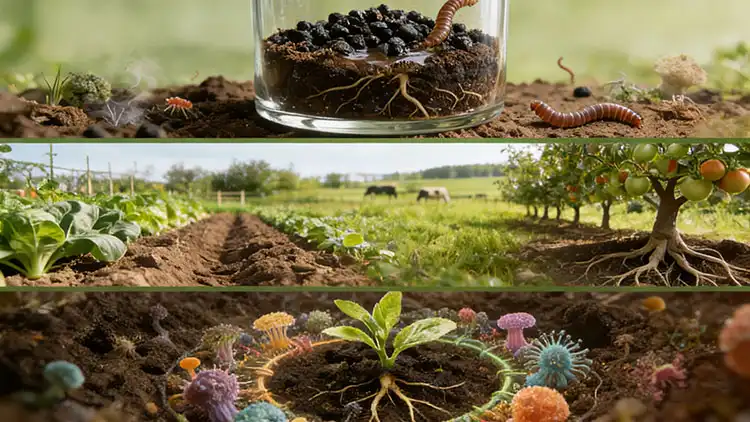
One of the best things about organic fertilizer is that it makes the soil better. Every so often adding organic matter to the soil can help it keep its shape better and give roots a better place to grow.
Normally, soils that are healthy offer:
-
More holes in the soil
-
Roots that go further
-
It keeps water in better.
-
Less weight on the soil
-
Nutrient supply that is more stable
On vegetable farms, parks, and greenhouses, plants can get more water and nutrients if the soil is better structured. This is especially true when the soil is dry.
Encouraging Beneficial Soil Microorganisms
You can find bacteria, fungi, and other microorganisms in soil. They change the way minerals move through the soil. The organic parts of organic fertilizer help bacteria do their job and make the soil better for plants.
In a world with more people, it can help:
-
Naturally break down plant food for food
-
Make it easy to get nutrients.
-
Help the roots get bigger.
-
Over time, keep the land more even.
Like this, organic fertilizer helps farmers who care more about taking care of the land over time than giving plants nutrients right now.
What Are the Environmental Benefits of Organic Fertilizer?
Reducing Nutrient Loss and Soil Pollution Risks
Stopping the soil from getting dirty and nutrients from being lost
Some nutrients may run off and pollute groundwater if crops don't fully use man-made fertilizers. This can happen if too many of them are used.
If organic fertilizer is used the right way, it may help lower these risks by:
-
letting go of life slowly
-
Leaving more nutrients in the soil
-
Getting rid of using too much fertilizer
-
Bettering the process of food cycles
What's good for the environment, though, depends on how the product is used and how good the soil is. If you want to use organic fertilizer, you should test it first and then do what the plants need.
Supporting Biodiversity and Carbon Management
A farming environment that is healthy needs a lot of organic matter to stay healthy. Adding organic fertilizer to the soil can help it hold more carbon and have more plant life in it.
People who grow plants often see more earthworms and better soil conditions when they switch from using a lot of chemical fertilizers to integrated organic nutrient management.
In order for farming to be useful, the soil needs to be healthy. This will help keep production stable and reduce stress on nearby ecosystems.
Where Is Organic Fertilizer Commonly Used in Agriculture?
Vegetable Production
Vegetable plants often need to have steady access to nutrients because their growing stages are short. It is possible for organic fertilizer to make the soil more waterlogged and help nutrients get to all the plants evenly.
Here are some common uses:
-
Having tomatoes and cucumbers
-
Spices
-
Plants that have leaves
The quality of the soil must be kept up between growing rounds in intense veggie production to get steady amounts.
Fruit Orchards
If you want fruit trees to grow in the same place for a long time, you need to keep an eye on the nutrients in the soil.
This is what organic fertilizer can do to help apple trees grow:
-
Getting the root zone dirt in better shape
-
Increasing the amount of living things
-
Increasing the amount of minerals available during fruit and flower growth
-
Grown crops in greenhouses
-
Planting the same things over and over in a greenhouse can make the soil flat and throw off the balance of nutrients.
Greenhouse Farming
Growers who use organic manure in greenhouses can keep the conditions better by:
-
Opening up the soil
-
The microbes at work
-
The right amount of water
-
How the dirt is built
-
Having fields and animals for farming
Pastures and Livestock Farming
Taking care of fields means making sure the dirt works well and the grass grows well.
It is possible to add more organic matter to the soil with organic fertilizer, which can help grass grow back after it has been grazed, especially in areas that have been damaged by drought or heavy livestock use.
Commercial Plantations
Organic fertilizer plans are being used by more and more large farms that grow herbs, coffee, tea, sugarcane, and other crops to make the soil last longer.
When used in factories, organic nutrition management can also help meet the needs of the market for eco-friendly production.
What Should Bulk Buyers Consider When Purchasing Organic Fertilizer?
For business farms, exporters, and dealers, choosing an organic fertilizer provider is more than just comparing prices. Consistency in products, testing standards, and expert help all have a direct effect on how well farming goes.
Important things to consider when buying are:
-
Organic certification and proof of compliance
-
Stable sources of raw materials
-
Reports on nutrient analysis
-
Pathogen and heavy metal tests
-
Consistency in batch quality
-
Production potential and dependability of delivery
-
Advice on how to grow different crops technically
Suppliers you can trust should give you clear product specs, quality reports, and advice on how to use their products based on the soil and the needs of your crops.
For buyers from other countries, having experience exporting and being good at transportation are also important because they need a steady supply during growing seasons.
Can Organic Fertilizer Provide Long-Term Economic Benefits?
Even though organic fertilizer may cost more at first than regular fertilizer, many farmers see it as an investment in the soil's long-term output.
Some possible economic benefits are
-
Less reliance on chemical inputs
-
Better use of water in the soil
-
More stable crop performance
-
Better quality goods for high-end customers
-
The dirt is less likely to get worse over time.
When the soil is healthy, growers don't have to work as hard to fix problems that come up because of not having enough nutrients, having bad soil structure, or losing organic matter.
When it comes to corporate farming, the cheapest fertilizer isn't always the best value. It's sometimes the organic fertilizer that keeps food output steady over a number of growing seasons.
What Should Bulk Buyers Consider When Purchasing Organic Fertilizer?
For business farms, exporters, and dealers, choosing an organic fertilizer provider is more than just comparing prices. Consistency in products, testing standards, and expert help all have a direct effect on how well farming goes.
Important things to consider when buying are:
-
Organic certification and proof of compliance
-
Stable sources of raw materials
-
Reports on nutrient analysis
-
Pathogen and heavy metal tests
-
Consistency in batch quality
-
Production potential and dependability of delivery
-
Advice on how to grow different crops technically
Suppliers you can trust should give you clear product specs, quality reports, and advice on how to use their products based on the soil and the needs of your crops.
For buyers from other countries, having experience exporting and being good at transportation are also important because they need a steady supply during growing seasons.
Can Organic Fertilizer Provide Long-Term Economic Benefits?
Even though organic fertilizer may cost more at first than regular fertilizer, many farmers see it as an investment in the soil's long-term output.
Some possible economic benefits are
-
Less reliance on chemical inputs
-
Better use of water in the soil
-
More stable crop performance
-
Better quality goods for high-end customers
-
Less likely that the dirt will get worse over time
Growers don't have to work as hard to fix problems caused by a lack of nutrients, bad soil structure, or loss of organic matter when the soil is healthy.
For industrial farming, the most cost-effective organic fertilizer isn't always the cheapest one. Sometimes, it's the one that keeps crop yields stable over several growing seasons.
Conclusion
With the right production and application, organic fertilizer can have big benefits for the earth. Organic fertilizer helps make farming systems healthy by improving the structure of the soil, supporting microbial activity, keeping more water in the soil, and promoting balanced nutrient cycling.
It is very important for farmers, dealers, and business buyers to find the right organic fertilizer provider. Better results come from having quality standards, tests that you can trust, steady output, and expert help.
Organic fertilizer isn't the only way to solve all of farming's problems, but it is a useful way to improve the health of the land and help farming become more sustainable. As the need for environmentally friendly farming grows around the world, organic fertilizer will continue to be a popular choice for companies that want to protect the environment and increase long-term productivity.
FAQ
1. How does organic fertilizer offer assistance in moving forward soil quality over time?
Organic fertilizer progresses soil quality by expanding natural matter substance and supporting advantageous microbial action. Over time, this makes a difference, making superior soil structure, improved air circulation, and more grounded water maintenance capacity. More beneficial soil conditions also advance more grounded root frameworks and more steady supplement accessibility for crops amid diverse development stages.
2. Is organic fertilizer appropriate for large-scale commercial farming?
Yes, numerous commercial ranches utilize organic fertilizer in vegetable generation, plantations, ranches, and nursery frameworks. Present-day natural definitions can bolster large-scale agribusiness through moderate and adjusted supplement discharge, make strides in soil science, and make long-term soil administration way better. Appropriate application timing and soil testing are critical for accomplishing reliable outcomes at scale.
3. What ought buyers to consider when purchasing organic fertilizer in bulk?
Bulk buyers ought to assess item certifications, crude fabric quality, supplement consistency, and provider unwavering quality sometime recently after obtaining natural fertilizer. Imperative variables incorporate OMRI or USDA Natural certification, overwhelming metal testing, generation capacity, specialized backing, and send-out coordination capabilities. Choosing a dependable producer makes a difference and guarantees steady item quality and long-term supply security.
Partner with Sciground for Premium Organic Fertilizer Solutions
Sciground specializes in premium organic fertilizer manufacturing for modern agricultural operations. Our formulations combine carefully selected organic matter, humic substances, and beneficial microorganisms to support crop productivity and long-term soil health.
We support global distributors, farms, and agricultural suppliers with:
- Stable bulk supply
- Customized formulations
- OEM/ODM manufacturing
- Technical documentation
- Quality testing support
- Export logistics coordination
Whether you need solutions for vegetables, orchards, greenhouse systems, or commercial plantations, our team can help develop the right nutrient strategy for your operation.
Contact Sciground today at [email protected] to request product specifications, bulk quotations, or customized organic fertilizer recommendations.
References
1. Smith, J.A., & Johnson, M.K. (2023). Environmental Impact Assessment of Organic versus Synthetic Fertilizers in Agricultural Systems. Journal of Sustainable Agriculture, 45(3), 234-251.
2. Brown, L.P., Davis, R.T., & Wilson, C.M. (2022). Soil Health Improvement through Organic Matter Additions: A Five-Year Commercial Study. Soil Science Society of America Journal, 86(4), 1123-1138.
3. Thompson, K.L., & Anderson, P.J. (2023). Carbon Sequestration Potential of Organic Fertilizer Applications in Agricultural Soils. Environmental Science & Technology, 57(12), 4789-4802.
4. Martinez, S.R., Lee, H.W., & Garcia, A.P. (2022). Microbial Community Enhancement and Disease Suppression in Organic Fertilizer-Amended Soils. Applied Soil Ecology, 178, 104567-104579.
5. Clark, D.M., Taylor, N.B., & Roberts, J.F. (2023). Economic Analysis of Organic Fertilizer Adoption in Commercial Agriculture: Long-term Cost-Benefit Assessment. Agricultural Economics Review, 31(2), 78-94.
6. White, R.K., Kumar, S.A., & Chen, Y.L. (2022). Nutrient Release Patterns and Environmental Fate of Organic Fertilizers: A Comparative Analysis. Nutrient Cycling in Agroecosystems, 124(1), 45-62.

Sciground
Shanrangde, in collaboration with a team of experts from the former Academy of Agricultural Sciences, focuses on developing patented organic fertilizers, including those specifically formulated for Corydalis rhizome. Chief expert Professor Liang Dejun, with over 20 years of industry experience, provides one-stop technical guidance from site selection to field management, helping farmers increase production and income.
Formulated by the original expert team from the Academy of Agricultural Sciences · Focused on organic nutrients specifically for crops
Contact us now to customize a green nutrition solution for your farmland.
Recommended Blog


How Do Organic Fertilizers Benefit Soil Health and Plant Growth?

How Does Balanced Liquid Fertilizer Help Plants Resist Disease?

How to Increase Gastrodia Root Quality with Specialized Fertilizer?


