Can Organic Fertilizer Improve Water Retention in Soil?
Why Does Soil Lose Water Too Quickly?
- Why Does Soil Lose Water Too Quickly?
- How Does Organic Fertiliser Improve Soil Water Retention?
- Organic Fertiliser vs Chemical Fertiliser for Water Retention
- What Are the Best Practices for Applying Organic Fertilizer?
- What Should Commercial Buyers Consider When Selecting Organic Fertilizer?
- Sciground Organic Fertilizer Solutions
- Conclusion
- FAQ
- Partner with Sciground for Superior Organic Fertilizer Solutions
- References
This is true. Organic fertiliser, also known as 'organic fertiliser', can help soil hold on to water much better by adding more organic matter, improving the structure of the soil, and encouraging good bacteria to work in the soil. Organic fertiliser helps rebuild the soil's physical and biological conditions that make it better at holding and releasing water. Synthetic fertilisers, on the other hand, mostly add nutrients to the soil.
It turns into humic substances and other steady chemicals that help the soil stay together better as it breaks down. These changes result in more uniform pore sizes. This lets the soil hold water while still letting enough air flow for roots to grow in a healthy way.
Better controlling the wetness of the soil is important for farms that have to deal with dry conditions, sandy soils, or a lot of farming. This will help keep crop growth stable and reduce the need to water.
Why Does Soil Lose Water Too Quickly?
A lot of farming soils can't hold enough water because they aren't structured properly or because the amount of organic matter in them has dropped.
Most of the time, low water absorption is brought on by the following:
-
Not many live things
-
Sandy soils that don't hold much water
-
Soil that has been pressed down by big machines
-
Microbes don't act much.
-
Managing nutrients in the long term that only look at chemical sources.
If the land isn't holding its water well, these are often signs:
-
The ground is drying out quickly after being wet.
-
Increasing how often plants are watered when they are growing
-
Putting something on top of the surface
-
Food doesn't grow well when it's dry.
-
When it rains a lot, nutrients are lost quickly.
Big pieces of soil make it harder for water to stay in sandy soils, so they are more likely to be affected. Water goes through the earth quickly if it doesn't have enough organic matter. This makes it harder for plant roots to get to.
Putting nutrients into the soil won't fix it for good in the long run. Making the soil's surroundings better is needed to make it better at holding water.
How Does Organic Fertiliser Improve Soil Water Retention?
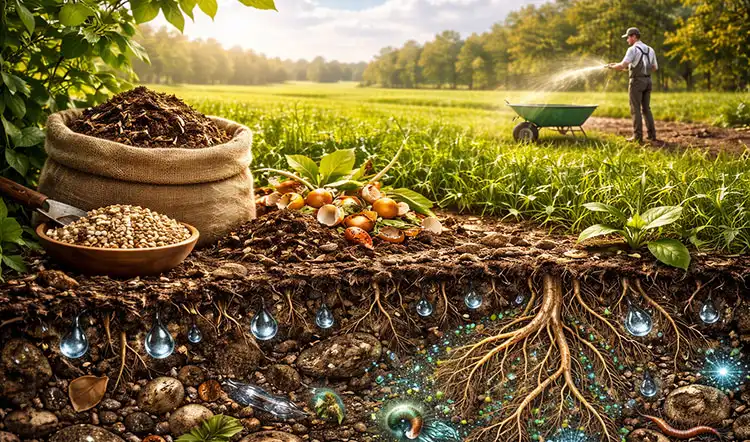
Organic fertiliser is great because it improves the soil over time, not just gives it nutrients for a short time. Organic sources improve the soil's organic matter, feed bacteria, and help it stick together better, all of which help water stay where it needs to be and be used more efficiently.
Increase Soil Organic Matter Content
Organic matter helps keep the soil's water level where it should be.
Adding organic matter to soil makes the carbon chemicals in it more solid so they can hold and soak up water. Because they naturally store water, these chemicals help the land keep water available between waterings.
A soil with more organic matter may also make it easier to find nutrients. This is because nutrients are more likely to stay in the structure of the soil instead of being washed away quickly.
This is what it helps with the most:
-
Sandy land for farming
-
Places where veggies are grown
-
Places that get uneven rain and have orchards
-
Better the soil's structure and how it sticks together.
Improve Soil Aggregation and Structure
With the help of humic substances and bacteria, organic fertiliser helps the soil form stable chunks. The dirt has holes of different sizes because of these chunks:
-
Small pores hold a lot of water.
-
More air can flow through and drain away through bigger holes.
-
Roots can grow deeper when pathways are stable.
Earth that is well-built through the use of organic fertiliser can hold water better and keep it from getting too wet.
With this, growers can be more sure that plants will get water, even when it's hot or doesn't rain much.
Support Beneficial Soil Microorganisms
Soil microorganisms are very important for the long-term health of the earth.
Microbial groups need carbon sources, which can be found in organic fertiliser. These bacteria help break down organic matter, keep soil particles fixed, and improve the way minerals move through the soil.
A good type of bacteria helps with the following:
-
The dirt will mix better.
-
Not as much packing down
-
Things got better with the roots.
-
More nutrients for the body
Soils that get a lot of organic matter tend to keep the right amount of water in them naturally better than soils that don't have many living things in them.
Organic Fertiliser vs Chemical Fertiliser for Water Retention
In gardening, chemical fertiliser and organic fertiliser are used for various tasks. There are two types of fertilisers: chemical and organic. Chemical fertilisers add nutrients quickly, while organic fertilisers work to improve the land over time.
Here are the changes in how much water each one can hold:
| Factor | Organic Fertilizer | Chemical Fertilizer |
|---|---|---|
| Organic matter contribution | High | Minimal |
| Soil structure improvement | Strong | Limited |
| Long-term water retention | Better | Lower |
| Nutrient release | Slow release | Fast release |
| Soil biology support | Yes | Limited |
Chemical fertilisers can quickly and effectively give plants the nutrients they need, but they don't usually add organic substances that make the soil better.
Organic fertiliser helps the soil stay better over time by adding more organic matter, encouraging microbe activity, and making the soil environment more stable.
If farms want to become less reliant on regular watering and better able to handle drought, using both proper nutrient management and organic soil improvement techniques can work better.
What Are the Best Practices for Applying Organic Fertilizer?
To keep the earth healthy and help it hold on to water, it's important to use organic fertilizer the right way. The best way to apply organic fertilizer relies on the earth, the food, and the amount of nutrients that are already there.
Test Soil Conditions Before Application
Before adding organic fertilizer, farmers should check how the soil is doing now.
Some important factors are
-
Level of organic stuff
-
Feel of the soil
-
pH level
-
Current state of nutrients
-
Conditions of moisture
Soil testing helps figure out how much fertilizer to use and keeps people from using too much.
For industrial farms, checking the soil regularly also helps keep an eye on changes in structure, water supply, and how well nutrients are used.
Combine Organic Fertilizer with Compost or Cover Crops
Organic fertilizer works better when used with other ways to make the soil better.
When you mix organic fertiliser with:
-
More organic matter in the earth can help it hold more water.
-
Cover crops, compost,
-
mulch can all do this.
Some plants, like cover crops, keep the soil's surface from getting too much direct sunlight and washing away. When they break down, they add more biological matter to the ground.
It's hard to keep the dirt wet all the time in dry places, but these two ways work great together.
Avoid Excessive Application
Lots of good things happen when you use too much organic fertiliser on the soil.
If you use too much, it could cause:
-
Imbalance of nutrients
-
Costs of production went up.
-
Less effective use of fertilizer
-
Unnecessary buildup of nutrients
Growers can get better results and protect the environment at the same time with a balanced fertiliser scheme based on soil research.
What Should Commercial Buyers Consider When Selecting Organic Fertilizer?
Getting organic fertiliser from the right supplier is a key part of good soil management for agricultural distributors, large farms, and commercial growers.
A reliable supplier should offer consistent technical support and high-quality products.
Some important rating factors are:
-
The amount of organic matter
-
Levels of humic substances
-
Parts of microbes
-
Certifications for products
-
Ability to make things
-
Stability in supply
-
Ability to deliver in bulk
Businesses should also check with a seller to see if they can make formulas that are specific to different crops, soil types, and regional farming needs.
Sciground Organic Fertilizer Solutions
Sciground makes organic fertilizer products that help improve soil, control water levels, and ensure long-term farming production.
Sciground goods help make the soil better and help plants grow better by mixing natural humic substances, plant-based organic materials, and helpful microbes.
Our organic fertiliser options are made to help with:
-
Better mixing of the soil
-
Better keeping of moisture
-
Better resistance to drought
-
Recovery of dirt that has been damaged by heavy use of chemicals
Sciground also offers the following for farming companies and distributors:
-
OEM solutions for fertilizer
-
Formulations made just for you
-
Support for bulk supplies
-
Help with technology
-
Distributors working together
Sciground helps customers make organic fertilizer plans that work for a variety of crops and soil types by offering professional preparation services and application-focused support.
Conclusion
Organic fertiliser can help the soil hold on to more water by adding more organic matter. This makes the soil's structure stronger and puts good bugs to work. Because of these changes, the soil can now hold more water, and plants can get water more often.
Organic fertiliser can help crops do better in the short term and make more in the long term as part of a full soil management plan. This is especially important if the dirt is getting dry, sandy, or bad.
You should think about the quality of the product, how well they can make it, how reliable their supply is, and how much technical support they offer when choosing an organic fertiliser supplier. The organic fertilisers that Sciground offers can help farms improve the soil and make growing systems that last longer.
FAQ
1. Can artificial fertilisers be replaced by organic fertilisers to keep water in the soil?
While organic fertilisers are great at increasing the long-term ability of soil to hold water, the most effective method is often a series of steps that eventually decrease the need for chemical fertilisers while increasing the amount of organic matter in the soil. It is possible to do a full replacement, but it might take two or three growing seasons to get the soil and microbes just right for getting the most water retention benefits.
2. When will the soil's ability to hold on to water start to get better?
When organic fertiliser is applied correctly, the soil's ability to hold water usually starts to improve within 6 to 8 weeks. After one full growing season, the changes become significantly better. The benefits are felt over two to three years, as the soil's organic matter content rises and its structure stabilises. This leads to long-lasting changes in the soil's ability to hold water and its general health.
3. What are the best ways to store and move organic fertilisers in bulk?
For proper storage, organic fertilisers need to be kept in dry, well-ventilated areas that keep them safe from wetness and temperature changes while keeping their integrity. Covered storage areas with concrete floors keep food from getting dirty or losing nutrients, and rotating products from first-in, first-out keeps them as fresh as possible. Crushing and compacting should be kept to a minimum with handling tools. These actions can make the coating less effective and uneven.
Partner with Sciground for Superior Organic Fertilizer Solutions
Are you ready to change how well your soil holds water with tried-and-true organic fertilizer technology? Sciground has solutions that are tailored to the needs of business farming companies that want to boost their long-term output. Our expert team helps you with everything, from choosing the right product to making the best use of it, so you get the most out of your fertilizer investment.
Get in touch with our experts right away at [email protected] to get product samples, bulk price quotes, and technical advice that is tailored to your particular needs. As a top company that makes organic fertilizer, we use both our scientific knowledge and our hands-on experience in the field to come up with solutions that improve both short-term results and the long-term health of the soil. Let Sciground help you make your grounds more durable and effective while also lowering your costs and the damage you do to the environment.
References
1. Johnson, M.R., Thompson, K.L., and Martinez, A.C. "Organic Matter Effects on Soil Water Retention in Agricultural Systems." Journal of Soil Science and Water Management, Vol. 45, No. 3, 2023, pp. 78-92.
2. Williams, D.P. and Chen, L.S. "Comparative Analysis of Chemical versus Organic Fertilizers on Soil Moisture Dynamics." Agricultural Water Conservation Research, Vol. 28, No. 2, 2022, pp. 156-171.
3. Anderson, R.J., Kumar, S., and Davis, M.E. "Microbial Communities and Water Retention in Organically Amended Soils." Soil Biology and Biochemistry International, Vol. 67, No. 4, 2023, pp. 234-248.
4. Brown, T.A. and Wilson, J.K. "Economic Benefits of Organic Soil Amendments for Water Conservation." Journal of Agricultural Economics and Sustainability, Vol. 31, No. 1, 2023, pp. 45-59.
5. Garcia, S.M., Liu, Y.F., and Patel, R.N. "Humic Acid Contributions to Soil Water Storage Capacity." Environmental Soil Science Quarterly, Vol. 19, No. 3, 2022, pp. 112-127.
6. Taylor, C.R. and Zhang, W.L. "Long-term Soil Health Improvements through Organic Fertilizer Applications." Sustainable Agriculture Research Review, Vol. 52, No. 2, 2023, pp. 89-104.

Sciground
Shanrangde, in collaboration with a team of experts from the former Academy of Agricultural Sciences, focuses on developing patented organic fertilizers, including those specifically formulated for Corydalis rhizome. Chief expert Professor Liang Dejun, with over 20 years of industry experience, provides one-stop technical guidance from site selection to field management, helping farmers increase production and income.
Formulated by the original expert team from the Academy of Agricultural Sciences · Focused on organic nutrients specifically for crops
Contact us now to customize a green nutrition solution for your farmland.
Recommended Blog


What Are Micronutrient Fertilizers and Why Are They Important for Plants?

How Do Organic Fertilizers Benefit Soil Health and Plant Growth?

Why Should You Use Balanced Liquid Fertilizer for Your Plants?

How to Increase Gastrodia Root Quality with Specialized Fertilizer?
_1767870624598.webp)
