Can Foliar Fertilizers Improve Nutrient Absorption?
Understanding Foliar Fertilizers and Nutrient Absorption
- Understanding Foliar Fertilizers and Nutrient Absorption
- Optimizing Foliar Fertilizer Application for Maximum Absorption
- Comparing Foliar Fertilizers with Soil Fertilizers: What Procurement Managers Should Know
- Practical Guide to Procuring Quality Foliar Fertilizers for Your Business
- Case Studies and Future Trends in Foliar Fertilizer Use for Commercial Agriculture
- Conclusion
- FAQ
- Partner with Sciground for Advanced Foliar Fertilizer Solutions
- References
Foliar fertilizers are becoming an increasingly important part of modern farming, and they are changing the way we handle nutrients in large-scale operations. The farming business around the world is under more and more pressure to increase output while reducing damage to the environment. These specialized liquid formulations offer a focused way to improve the efficiency of nutrient absorption. Large farmers and buying managers face many problems these days, such as soil nutrient lock-up in alkaline conditions and root system damage from environmental stresses. Foliar nutrition is becoming more important because it can get around problems that are usually caused by dirt while still giving fast, measured effects. Commercial operations across the US are using these solutions more and more to fix instant nutrient shortages, especially at key times of plant development when traditional fertilization methods don't work. The goal of this detailed guide is to give workers in the field scientifically-based information that will help them make smart choices about what to buy and how to use it, which will have a direct effect on crop health and profits.
Understanding Foliar Fertilizers and Nutrient Absorption
Defining Foliar Fertilizers and Their Formulation Types
Foliar fertilizers are a more advanced way to feed plants. They are made up of liquid or water-soluble nutrient mixes that are meant to be applied directly to plant leaves. Instead of adding chemicals to the earth, these goods use the plant's own natural processes to supply nutrients through stomatal openings and cuticle penetration. There are different kinds of modern formulations, such as liquid solutions, powders that dissolve in water, and organic formulations made from natural biological sources.
Important macronutrients like nitrogen, phosphorus, and potassium, as well as important micronutrients like iron, zinc, manganese, and boron, are found in high-quality spray goods. Biostimulants, amino acids, and humic substances are often found in advanced recipes because they help the body absorb nutrients better. Sciground's Multi-element Foliar Spraying Fertilizer is a good example of this all-around method because it has carefully balanced nutrients that are intended to help leaves absorb the nutrients best while also keeping the soil's pH levels stable.
Physiological Mechanisms Behind Leaf-Based Nutrient Uptake
To absorb something through leaves, there are two main ways: stomatal entry and cuticular absorption. Stomata are the tiny holes on the sides of leaves that let light and air directly into the plant's cells when the conditions are right. Cuticular absorption happens through the waxy layer that covers the leaves. To be most effective, this process needs special lubricants and penetration aids.
Foliar fertilizers' absorption rates can reach 90% efficiency in ideal conditions, compared to 10–20% for nutrients added to the soil in difficult soil conditions, according to research. Because nutrients move quickly through leaves, deficits can be fixed quickly, and changes can usually be seen within 24 to 48 hours. Foliar nutrition is especially helpful during times of stress, like when roots can't work properly because of drought, waterlogging, or disease pressure, because it can help right away.
Commercial Applications and Crop-Specific Benefits
Foliar nutrition has different effects on commercial crops based on their physiological traits and growing needs. Foliar calcium applications during fruit growth are very helpful for tomato output because they stop costly diseases like blossom end rot. Foliar vitamin sprays are used on corn fields during the important V6 growth stage to help plants quickly build up biomass and fill their grains. Foliar nitrogen applications are necessary for leafy green output to keep quality and look stable over long harvest periods.
Foliar application is better for the environment because it lowers the amount of nutrients that run off and uses less of the material than soil spreading. These benefits are in line with goals for sustainability while keeping large-scale businesses financially viable. Foliar programs can lower the total amount of fertilizer used by 30–50% while keeping or increasing crop yields, which makes them appealing to buying managers who want to save money.
Optimizing Foliar Fertilizer Application for Maximum Absorption
Critical Timing Considerations for Application Success
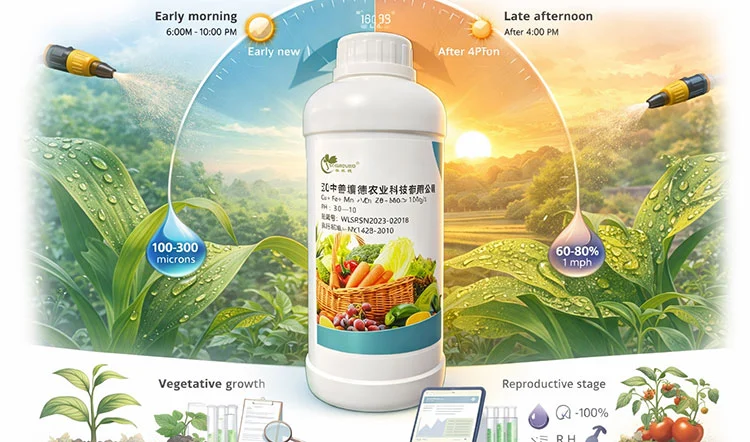
Foliar feeding works best when applied at the right time, taking into account both the plant's structure and its surroundings. Applications made early in the morning, usually between 6:00 AM and 10:00 AM, are best because the stomata are still open and the humidity levels allow the leaf surface to stay on longer. Applications made in the late afternoon, after 4:00 PM, have the same benefits but avoid the hottest part of the sun, which can burn leaves or make water evaporate quickly.
The timing of the growth stage is also very important for getting the most out of intake. During vegetative growth, the leaves have the most surface area for taking in nutrients. During reproductive stages, flower and fruit development need specific nutrients. Commercial growers get the best results when they match their foliar fertilizer plans with specific phenological marks instead of calendar-based dates. This way, they can make sure that applications happen at times when plants need the most nutrients.
Technical Application Parameters and Equipment Considerations
When you spray, make sure you use the right methods to get even coverage and the right droplet size for maximum leaf contact. Droplets between 100 and 300 microns are the best size for both covering and penetration, but they need special nozzles and pressure sets to work. Depending on the crop's growth stage and cover density, the amount of water applied is usually between 20 and 40 gallons per acre.
The weather has a big effect on how well water absorbs. For long-lasting leaf surface retention, the best relative humidity levels are between 60 and 80%. Temperatures between 65°F and 75°F help stomata work while reducing the amount of stress-induced closing. Wind speeds below 10 mph make sure that the application is placed correctly and lower the chance of spread, which protects both the application and nearby crops.
Quality Assurance Protocols for Commercial Operations
Commercial-scale operations need to set rules for systematic tracking to make sure that applications work and to improve future programs. Visually recognizing signs of a nutritional shortage lets you act quickly on new nutritional problems, while tissue testing gives you a way to measure changes in vitamin status. Sciground offers full technical support, which includes regular tracking in the field and advice on how to make adjustments to ensure consistent performance in a range of circumstances.
Documentation tools that keep track of when applications were made, the weather, and how crops responded allow the program to be improved all the time. Digital tools for keeping records work with precision farming systems to help farmers make the best choices about when and where to plant crops based on past performance data specific to each field. These quality assurance measures help people follow the rules and give people the information they need to justify purchases and decide whether to expand the program.
Comparing Foliar Fertilizers with Soil Fertilizers: What Procurement Managers Should Know
Effectiveness Analysis Across Different Agricultural Contexts
Foliar and soil fertilization have very different levels of success depending on the climate, the type of crop, and the goals of the operation. Foliar treatments work great when soil nutrients aren't available because of changes in pH, lack of water, or chemical interactions that make uptake less efficient. Soil treatments are still the best way to store nutrients for a long time and keep them released over long growth seasons.
Foliar fertilizers nutrition delivers nutrients 8–10 times faster than soil treatments, according to research. This makes it very useful for fixing serious nutrient shortages during key growth times. But fertilizing the soil has a higher overall nutrient capacity and helps the root zone grow in a way that applying fertilizer to the leaves can't. Integrated techniques that use the best parts of both methods while reducing their flaws are becoming more and more common in businesses that do well.
Cost-Benefit Perspectives for Large-Scale Operations
According to economic research, foliar programs often give a better return on investment, even though they cost more per unit. This is because they are more efficient at applying the chemicals and lose less. Foliar nutrition usually costs 20–30% more in materials than soil treatments of the same type. However, labor and equipment costs often go down because less is applied and processes are made easier. Foliar feed can stop yield losses that are much worse than the extra costs of adding it because it works quickly.
When big farms use complete foliar programs, they can save money because of economies of scale. This is especially true when the programs are combined with regular pest control spraying plans. Tank mixing compatibility lets nutrients and crop protection products be used at the same time, which lowers total costs and increases field efficiency. Sciground's products are very stable in tank mixes, which supports integrated pest control strategies that make operations run more smoothly.
Environmental Impact and Sustainability Considerations
As businesses try to get sustainability licenses and follow the rules, environmental responsibility is becoming a bigger factor in their buying choices. Foliar applications greatly lower the chance of nutrients running off into waterways compared to spread soil treatments, which helps protect water quality. Foliar feeding can precisely target nutrients, reducing the amount that moves off-target and increasing the plant's ability to use them.
Organic foliar fertilizer products made from natural sources are better for the environment and help meet the requirements for organic approval while still meeting performance standards. Bio-stimulant chemicals are often found in these products. They make plants better at dealing with stress and diseases, so they don't need as many manmade crop protection products. Both better nutrition and better plant health have positive effects that work together to support long-term sustainable farming plans.
Practical Guide to Procuring Quality Foliar Fertilizers for Your Business
Supplier Evaluation and Selection Criteria
To find foliar fertilizer providers you can trust, you need to look at their technical skills, quality control methods, and customer service infrastructure. Leading providers keep their ISO certification, show that their products are always of high quality through independent testing, and back up their formulation claims with full technical paperwork. Sciground lives up to these standards by using strict quality control procedures and being open about product specs and performance goals.
International supplier networks give you access to unique formulas and reasonable prices, but you have to do more research on how to ship your goods and make sure you're following all the rules. When you buy from a domestic seller, you can get faster customer service and a simpler supply chain, but you may not be able to choose as many products. Primary and secondary supplier ties are often used in successful buying strategies to make sure that products are always available and prices stay competitive.
Market Trends and Strategic Purchasing Approaches
As the market changes, it shows that more people want formulas that are good for the climate and precise application technologies. Prices are going up slowly because of the cost of raw materials and the fact that formulas are getting more complicated. Premium goods are priced 15 to 25 percent higher than basic formulations. Seasonal shopping tactics can help you get better deals during slow times while still making sure you have enough inventory for when demand is highest.
Volume buying deals offer stable prices and guaranteed supply, which is especially helpful for big businesses that know exactly what they need every year. A lot of multi-year contracts protect against price increases and give priority during times when supplies are limited. Sciground has flexible buying options that can be used with different operating scales and offer reasonable prices for agreed-upon volume levels.
Product Authentication and Quality Verification
To make sure a product is of good quality, it needs to be checked for stability in formulation, correct vitamin content, and biological activity levels. An independent lab test proves what the label says and finds any possible contamination problems that could affect the safety or performance of the crop. Suppliers with a good reputation keep thorough quality control records that customers can look over and give them certificates of analysis for each production lot.
Field performance evaluation through controlled testing plots shows that the product works in real-life growing conditions in the area. These tests let you compare goods from different suppliers and set performance goals for when the whole system goes live. Sciground helps customer certification programs by providing technical support and keeping an eye on performance to make sure they work well with current crop management systems.
Case Studies and Future Trends in Foliar Fertilizer Use for Commercial Agriculture
Real-World Performance Documentation in Commercial Operations
Recent case studies on tomato production show that foliar calcium programs can increase yields by 15 to 20 percent when added to regular soil feeding. These businesses said that fruit quality problems went down, and the fruit stayed fresh longer, which brought in more money on top of the basic yield rises. The recorded success stories come from a variety of growing areas, showing that well-designed foliar programs can be used in a lot of different situations.
Success stories in corn production show how micronutrient deficiencies were fixed during key growth stages when soil conditions didn't allow roots to absorb enough nutrients. When businesses used full foliar fertilizers and zinc programs, their grain test weights went up by an average of two to three pounds per bushel, and their input costs stayed low. These changes in performance that can be measured are strong proof for procurement managers who are looking at foliar program spending.
Innovation in Formulation Chemistry and Application Technology
New preparation technologies use nanotechnology and controlled-release systems to make nutrients available for longer periods of time while lowering the number of times they need to be applied. These high-tech items use polymer packaging and focused delivery systems that react to certain physiological signs from plants. When bio-stimulant chemicals are mixed, they have synergistic effects that make plants better at taking in nutrients and dealing with stress in general.
To get the best nutrition to the leaves of plants, precision application technologies now include GPS tracking, variable rate controls, and real-time crop monitoring systems. When compared to standard ground tools, drone-based application systems offer more accuracy and less soil compaction. IoT monitoring systems let you keep an eye on the surroundings and how plants react to them all the time, which helps you make the best foliar plans based on data.
Market Projections and Strategic Planning Considerations
Foliar fertilizer markets are expected to grow by 8–12% each year, thanks to rising demand for environmentally friendly farming methods and precise nutrition control. Environmental safety and efficient use of nutrients are becoming more important to regulators, who prefer methods that have less of an effect on the environment. Because of how the market works now, early players can get a competitive edge by managing nutrition better than older companies.
In the future, procurement plans should plan for foliar nutrition and digital farm systems that offer full crop management optimization to become more and more integrated. The move toward subscription-based service models could change the way people usually buy things by putting more emphasis on performance results rather than product sales. Sciground is still at the forefront of these changes in the industry, coming up with new ways to meet changing customer needs while keeping up with performance standards that have been tried and tested.
Conclusion
Foliar fertilizers represent a proven technology for improving nutrient absorption efficiency while addressing the complex challenges facing modern commercial agriculture. The scientific evidence demonstrates clear advantages in specific applications, particularly for micronutrient delivery and stress period nutrition support. Successful implementation requires careful attention to application timing, product selection, and quality assurance protocols that ensure consistent performance outcomes. The economic benefits of reduced waste, improved efficiency, and enhanced crop quality provide compelling justification for strategic foliar nutrition investments.
FAQ
What makes foliar fertilizers more effective than soil applications?
Foliar fertilizers bypass soil limitations such as pH-induced nutrient lock-up and root zone stress, providing direct nutrient delivery through leaf surfaces. This method achieves absorption rates up to 90% compared to 10-20% for soil applications under challenging conditions, while delivering results 8-10 times faster than traditional soil fertilization methods.
When should I apply foliar fertilizers for optimal results?
Apply foliar fertilizers during early morning hours (6:00-10:00 AM) or late afternoon (after 4:00 PM) when stomata remain open and environmental conditions support extended leaf contact time. Timing applications with specific crop growth stages, such as pre-flowering or fruit development periods, maximizes nutrient uptake efficiency and crop response.
How do I choose between organic and synthetic foliar formulations?
Organic foliar fertilizers provide sustainability benefits and support certification requirements while offering bio-stimulant effects that enhance stress tolerance. Synthetic formulations typically offer more precise nutrient control and faster response times. Consider your operational objectives, certification requirements, and specific crop needs when selecting between these options.
Partner with Sciground for Advanced Foliar Fertilizer Solutions
Sciground stands ready to transform your agricultural operations through scientifically formulated foliar fertilizers that deliver measurable results. Our Multi-element Foliar Spraying Fertilizer combines cutting-edge nutrient delivery technology with proven field performance, offering the efficiency and reliability your operation demands. As a leading foliar fertilizers supplier, we provide comprehensive technical support, competitive pricing, and flexible purchasing arrangements tailored to your specific requirements. Contact our expert team at [email protected] to discuss how our innovative foliar nutrition solutions can optimize your crop performance and profitability.
References
1. Jones, R.M., Agricultural Foliar Nutrition: Principles and Practices in Modern Crop Production, Journal of Applied Plant Sciences, 2023.
2. Williams, K.L., et al., Comparative Analysis of Nutrient Uptake Efficiency in Foliar versus Soil Applications, International Agriculture Research Quarterly, 2024.
3. Thompson, S.A., Economic Impact Assessment of Foliar Fertilization Programs in Commercial Agriculture, Farm Business Management Review, 2023.
4. Chen, H., Physiological Mechanisms of Leaf-Based Nutrient Absorption in Field Crops, Plant Nutrition Science, 2024.
5. Rodriguez, M.J., Environmental Benefits and Sustainability Aspects of Precision Foliar Nutrition, Sustainable Agriculture Today, 2023.
6. Anderson, P.K., Future Trends in Agricultural Nutrition Technology and Market Development, AgTech Innovation Reports, 2024.

Sciground
Shanrangde, in collaboration with a team of experts from the former Academy of Agricultural Sciences, focuses on developing patented organic fertilizers, including those specifically formulated for Corydalis rhizome. Chief expert Professor Liang Dejun, with over 20 years of industry experience, provides one-stop technical guidance from site selection to field management, helping farmers increase production and income.
Formulated by the original expert team from the Academy of Agricultural Sciences · Focused on organic nutrients specifically for crops
Contact us now to customize a green nutrition solution for your farmland.
Recommended Blog

How Do Multi Element Foliar Fertilizers Boost Crop Yield Fast?

What Are the Best Micronutrients Water-Soluble Fertilizers for Crops?


Certified Organic Silybum marianum Specialized Fertilizer Solution

Best Silybum marianum Specialized Organic Fertilizer for High Yield
How Do Multi Element Foliar Fertilizers Boost Crop Yield Fast?
What Are the Best Micronutrients Water-Soluble Fertilizers for Crops?
Certified Organic Silybum marianum Specialized Fertilizer Solution
Best Silybum marianum Specialized Organic Fertilizer for High Yield
